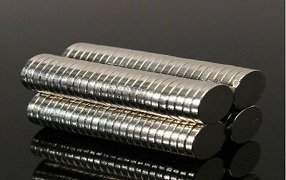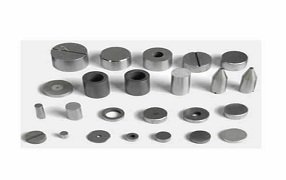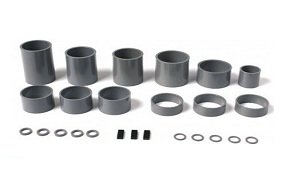
Ceramic, or ferrite, magnets are made of a sintered composite of powdered iron oxide and barium/strontium carbonate ceramic. Given the low cost of the materials and manufacturing methods, inexpensive magnets (or non-magnetized ferromagnetic cores, for use in electronic components such as portable AM radio antennas) of various shapes can be easily mass-produced. The resulting magnets are non-corroding but brittle and must be treated like other ceramics.
Comprised of sintered iron oxide and barium or strontium carbonate, ceramic or ferrite permanent magnets are typically inexpensive and easily produced, either through sintering or pressing. However, because these magnets tend to be brittle, they require grinding using a diamond wheel. They are one of the most commonly used types of magnet, and are strong and is not easy to demagnetize.
Ceramic or Ferrite magnets are generally formed by a compression or extrusion molding technique which is then followed by sintering. Finish grinding or shaping, when necessary for better control of dimensions, is normally done by using diamond grinding wheels. The material to be molded can be in either a dry powder or wet slurry form. Magnetic performance can be increased in a preferred direction by applying a magnetic field in that direction during the molding process.
Ceramic Magnets can be categorized as Soft, Semi hard and Hard Ferrite Magnets which refers to their low or high magnetic coercivity.
Soft ferrites
coercivity so called soft ferrites. The low coercivity means the materials can easily reverse direction without dissipating much energy (hysteresis losses) while the material’s high resistivity prevents eddy currents in the core, another source of energy loss. Because of their comparatively low losses at high frequencies, they are extensively used in the cores of RF transformer and inductors in applications such as switched-mode power supplies and loop stick antennas used in AM radios.
The Most Common Ferrite Magnets are: -
• Manganese Zinc Ferrite
• Nickle Zinc Ferrite
Semi Hard Ferrite
Cobalt ferrite, CoFe2O4 (CoO•Fe2O3), is in between soft and hard magnetic material and is usually classified as a semi-hard material. It is mainly used for its magnetostrictive applications like sensors and actuators thanks to its high saturation magnetostriction (~200 ppm). CoFe2O4 has also the benefits to be rare-earth free, which makes it a good substitute for Terfenol-D. Moreover, its magnetostrictive properties can be tuned by inducing a magnetic uniaxial anisotropy. This can be done by magnetic annealing, magnetic field assisted compaction, or reaction under uniaxial pressure. This last solution has the advantage to be ultra-fast (20 min) thanks to the use of spark plasma sintering. The induced magnetic anisotropy in cobalt ferrite is also beneficial to enhance the magnetoelectric effect in composite.
Hard ferrites
In contrast, permanent ferrite magnets are made of hard ferrites, which have a high coercivity and high remanence after magnetization. Iron oxide and barium or strontium carbonate are used in manufacturing of hard ferrite magnets. The high coercivity means the materials are very resistant to becoming demagnetized, an essential characteristic for a permanent magnet. They also have high magnetic permeability. These so-called ceramic magnets are cheap, and are widely used in household products such as refrigerator magnets. The maximum magnetic field B is about 0.35 tesla and the magnetic field strength H is about 30 to 160 kilo ampere turns per meter (400 to 2000 oersteds). The density of ferrite magnets is about 5 g/cm3.
The most common hard ferrites are:
• Strontium ferrite, SrFe12O19 (SrO•6Fe2O3)
• Barium ferrite, BaFe12O19 (BaO•6Fe2O3)
Alnico magnets are made by casting or sintering a combination of aluminum, nickel and cobalt with iron and small amounts of other elements added to enhance the properties of the magnet. Sintering offers superior mechanical characteristics, whereas casting delivers higher magnetic fields and allows for the design of intricate shapes. Alnico magnets resist corrosion and have physical properties more forgiving than ferrite, but not quite as desirable as a metal. Trade names for alloys in this family include: Alni, Alcomax, Hycomax, Columax, and Ticonal.
Alnico magnets get their name from the first two letters of each of three main ingredients: aluminum, nickel, and cobalt. Although they feature good temperature resistance, they can easily be demagnetized and are sometimes replaced by ceramic and rare earth magnets in certain applications. They can be produced by either sintering or casting, with each process yielding different magnet characteristics. Sintering produces enhanced mechanical traits. Casting results in higher energy products and enables the magnets to achieve more complicated design features.
First Cast alnico is produced using resin bonded sand molds. Sintered alnico magnets are formed using powdered metal manufacturing methods. Sintering alnico is suitable for complex geometries.
Most alnico produced is anisotropic, meaning that the magnetic direction of the grains is oriented in one direction. Anisotropic alnico magnets are oriented by heating above a critical temperature and cooling in the presence of a magnetic field. Both isotropic and anisotropic alnico require proper heat treatment to develop optimal magnetic properties—without it alnico's coercivity is about 10 Oe, comparable to technical iron, which is a soft magnetic material. After the heat treatment alnico becomes a composite material, named "precipitation material"—it consists of iron- and cobalt-rich. precipitates in rich-NiAl matrix.
Alnico's anisotropy is oriented along the desired magnetic axis by applying an external magnetic field to it during the precipitate particle nucleation, which occurs when cooling from 900 °C (1,650 °F) to 800 °C (1,470 °F), near the Curie point. Without an external field there are local anisotropies of different orientations due to spontaneous magnetization. The precipitate structure is a "barrier" against magnetization changes, as it prefers few magnetization states requiring much energy to get the material into any intermediate state. Also, a weak magnetic field shifts the magnetization of the matrix phase only and is reversible.
| Typical Composition of AlNiCo Magnet | |
|---|---|
| Aluminum (Al) | 7% - 11% |
| Nickel (Ni) | 15% – 26% |
| Cobalt (Co) | 5% - 30% |
| Copper (Cu) | 4% - 7% |
| Titanium (Ti) | 0% -5% |
| Niobium (Nb) | 0% -4% |
| Iron (Fe) | Balance (32% -39%) |
Injection-molded magnets are a composite of various types of resin and magnetic powders, allowing parts of complex shapes to be manufactured by injection molding. The physical and magnetic properties of the product depend on the raw materials, but are generally lower in magnetic strength and resemble plastics in their physical properties.
The very much first step for the production of Injection Molded Machine or Plastic Bounded Magnets is the production of magnetic Compound. Magnetic Compound is mixed by plastic granulate and the Magnetic Powder in a hot melt kneading or a twin screw extruder before they are extruded or granulated. Then the compound is processed with modified injection molding machines. When the injection molding anisotropic magnets, a magnetic field in an axial, radial, diametric or multi-polar direction is also created during the injection process. It generates the preferred direction of the magnetic material parallel to the given orientation. With injection mold, the magnet has advantages in designing an optimized design as complex shape with good mechanical tolerances and magnetic pattern has unlimited possibilities. This method requires a customized mold tool for each and every magnet. The magnets can be Isotropic or Anisotropic depending on material required magnetic properties or alignment. Rare Earth magnet materials such as NdFeB, SmCo and SmFeN can molded as well as Ferrite material.
The magnet powder must have a binder to be able and be molded and polymers.
The density of these magnets is lower compared to the magnets produced by sintering. This results in lower magnetic values.
Plastic-bonded hard ferrite magnets
In the manufacturing process for rigid plastic bonded hard ferrite magnets, particles with permanent magnetic properties from barium or strontium ferrite are embedded into a thermoplastic. In achieving magnetism, volume of hard ferrite powder is a decisive factor. Plastic bounded magnets will have weaker magnetic properties at the same volume than sintered isotropic magnets. Higher magnetic values can be achieved with anisotropic plastic bounded hard ferrite magnets, however not reaching the level of sintered anisotropic hard ferrite magnets.
Plastic-bonded NdFeB magnets
Magnets based on neodym-iron-boron are among the newest generation of permanent magnet materials. Plastic- bounded NdFeb magnets are especially used where hard ferrite magnets cannot meet magnetic specification or where sintered rare earth magnets are not economical or production related reasons. This magnet can be magnetized in any direction with any number of poles because they are generally magnetically isotropic.
Flexible magnets are composed of a high-coercivity ferromagnetic compound (usually ferric oxide) mixed with a plastic binder. This is extruded as a sheet and passed over a line of powerful cylindrical permanent magnets. These magnets are arranged in a stack with alternating magnetic poles facing up (N, S, N, S...) on a rotating shaft. This impresses the plastic sheet with the magnetic poles in an alternating line format. No electromagnetism is used to generate the magnets. The pole-to-pole distance is on the order of 5 mm, but varies with manufacturer. These magnets are lower in magnetic strength but can be very flexible, depending on the binder used.














Phone+91 8153 969 959
EmailEnquiry@nuveqcorp.com
Address204, World Trade Centre, Sayajiganj, Vadodara - 390020