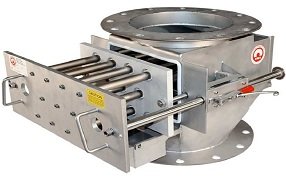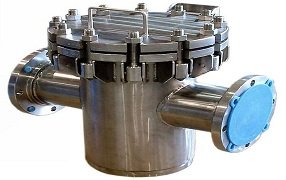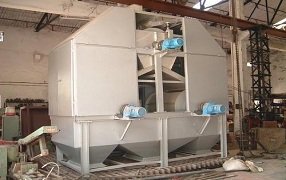
This type of ferrous metal removal unit can be fitted simply in existing pipe line or outlet of various equipments like pulverisor, blenders, & classifier or any other outlet location. In standard type each unit comprises to permanent magnetic grids mounted one above the other. system with multiple grids are available for special application. The grids are easily removable for cleaning. The drawer is fitted with flanges at outlet. As standard the magnetic rods consisting hard ferrite ceramic magnets or high intensity rare earth magnet is fitted in a sturdy steel housing. Model with stainless steel grids and housing can be supplied if required.
Application
| • Mining industries |
| • Pharmaceuticals industries |
| • Food processing industries |
| • Industries dealing with powdery substance |
| • Cement, gypsum and other types of small scale industries. |
| • Industries handling food |
| • Cement manufacturers |
Electromagnets, devices that create a magnetic field through the application of electricity. Wrecking yards’ employ extremely powerful electromagnets to move heavy pieces of scrap metal or even entire cars from one place to another. Your favorite band uses electromagnets to amplify the sound coming out of its speakers. And when someone rings your doorbell, a tiny electromagnet pulls a metal clapper against a bell. Mechanically, an electromagnet is pretty simple. It consists of a length of conductive wire, usually copper, wrapped around a piece of metal. Like Frankenstein’s monster, this seems like little more than a loose collection of parts until electricity comes into the picture. But you don’t have to wait for a storm to bring an electromagnet to life.
A current is introduced, either from a battery or another source of electricity, and flows through the wire. This creates a magnetic field around the coiled wire, magnetizing the metal as if it were a permanent magnet. Electromagnets are useful because you can turn the magnet on and off by completing or interrupting the circuit, respectively. electromagnets differ from your run-of-the-mill "permanent" magnets, like the ones holding your Popsicle art to the fridge. As you know, magnets have two poles, "north" and "south," and attract things made of steel, iron or some combination thereof. Like poles repel and opposites attract (ah, the intersection of romance and physics). For example, if you have two bar magnets with their ends marked "north" and "south," the north end of one magnet will attract the south end of the other. On the other hand, the north end of one magnet will repel the north end of the other (and similarly, south will repel south). An electromagnet is the same way, except it is "temporary" -- the magnetic field only exists when electric current is flowing.
The doorbell is a good example of how electromagnets can be used in applications where permanent magnets just wouldn’t make any sense. When a guest pushes the button on your front door, the electronic circuitry inside the doorbell closes an electrical loop, meaning the circuit is completed and “turned on.” The closed circuit allows electricity to flow, creating a magnetic field and causing the clapper to become magnetized. The hardware of most doorbells consist of a metal bell and metal clapper that, when the magnetic charges causes them to clang together, you hear the chime inside and you can answer the door. The bell rings, the guest releases the button, the circuit opens and the doorbell stops its infernal ringing. This on-demand magnetism is what makes the electromagnet so useful.
The electro over band magnet has the deepest holding field and is therefore the most suitable of all the over band magnets for the removal of Fe particles from material streams with thick layers. Disadvantages are the higher power consumption and higher weight relative to the permanent over band magnets.
An over belt magnet is suitable for removal or separation of high volumes of iron or steel and hangs above a flat- or trough-shaped conveyor. This type of magnet is self-cleaning and continuously separates (ferromagnetic) Fe parts from material streams. The deferrization efficiency of over belt magnets varies from 70 to 90%; this depends on magnet design, product flow and placement. Automatic self-cleaning over belt magnet separators are suitable for both the recovery (recycling) of ferrous parts and the removal/elimination of impurities (iron contaminants).
These magnets are mainly suitable for coarser fractions with pieces larger than 10 mm. Thanks to the robust, reliable technology, these magnets have applications in many industries. Putting a permanent over belt magnet in service requires nothing more than four suspension points, sufficient space and power to drive the conveyor belt.
Permanent Magnetic Grill are used for separation of iron particles mixed with dry, granular or free flowing material. Magnetic Grill are made by using stainless steel frames (Round, Square or Rectangular) with Magnetic Rods inside the frame.
Magnetic grids are often placed at a pouring point and filter very fine magnetic and weakly magnetic ferromagnetic contamination from free-flowing powders and granulates. Often used for control purposes. Manual cleaning (quick cleaning).
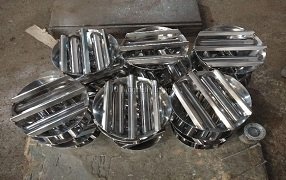
Food Grade Magnetic Grate with Full Welding and Well Polishing. Grate Magnet is a specially made product that is used in the removal process of small-sized to medium ferrous tramp metal impurities from those dry and free-flowing products presented in vertical chutes, housings, and catch bins. It is the best and economical solution for the magnetic protection of equipment like extruding, milling and mixing. It enhances the purity of the product as well. Grate magnets are also known as magnetic grate separators. It is used in the ferrous separation in bins, hoppers and those circular enclosures. It comes in two variants like ceramic as well as rare earth grate magnets. These are made with one-inch diameter magnetic Tubes and fixed in two-inch of centers in a frame for better built. The length and width of these grates can be fabricated to any dimensions as per requirement. The cleaning is done after removing the grate magnet and cleaning the magnetic tubes. With grate magnets the stored metal impurities are pushed to the Underside of the tube and prevent the clean material to get affected. The grate magnets can be arranged inside the hoppers or pits Without much difficulty.
Low Intensity Magnetic Grill having Gauss value of approximately 2,500 Gauss are ideal for trapping contamination such as Nuts, Bolts, Screws, broken washers etc. these grills are designed to attract larger iron pieces from relatively larger distance.
Medium Intensity Magnetic Grill having Gauss value of approximately 5,500 Gauss are used where the contamination is in particle form, however there may or may not be continuous flow of material to be separated. The contamination size may be as low as 150 microns but not lower than that. The material should be free flowing and non-sticky.
High Intensity Magnetic Grill having Gauss value of approximately 10,000 Gauss are employed at locations where separation of contamination particles as small as 1 micron is required. These grills have been designed to attract super fine particles from the carrier material.
Applications
| • Plastic | • Refractory |
| • Ceramic | • Mineral |
| • Pharmaceutical | • Pigments |
| • Food Products. (Sugar, Coffee, Tea, Grains, Pulses, Flour, Spices, Milk etc.) | • Chemical |
| • Colors / Paints | • Ink |
| • Raw materials, etc. in powder form. They can be installed in hoppers, chutes, etc. |
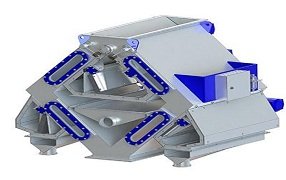
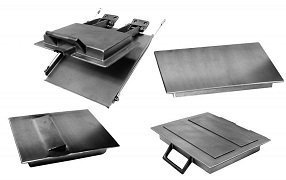
Hump Magnets offered are used for meeting the separation demands of iron particles from the plastic pallet, grain, seeds, woven fabric, free-flowing powder. These come in two plate magnets construction that is mounted on offset housing and are installed in vertical spouts that provide for achieving excellent separation of poor flow based, high volume or abrasive materials. This type of separation system is used wherever it is necessary to separate the ferromagnetic particles from undesirable large quantities of bulk material. Cascade system can be delivered in a manually operated or automatically converted. The design of the system is in a 4 mm thick stainless steel.
Cascade systems have a wide range of applications and are easy to install in existing transport routes. To the output of the system can include a valve that makes cleaning system from unwanted iron particles (see. Figure). Once the flap is open, it is possible to delete the unwanted ferrous particles from the separator into a prepared collection system (tank, conveyor, slip, etc.). With automatic version to clean up the system just press a button. All components comply automatically converted to ISO and CETOP. Each model may be further provided with inspection windows.
Cascade separators are equipped with FDA thatched magnets. If desired for particular applications, may be provided with a plate-shaped cascade system magnets FDL or FDL / C (plate-shaped magnet in the socket Omega / plate magnet with inclined pole
• It consists of ‘z’ type of shape chute made out of S.S. Construction placing magnet plate in such a way that maximum material will pass through the magnetic plate at the same time due to z tube of chute construct, material will again fall on another magnetic plate due to tumbling effect maximum material come in contact with magnetic plate. Hump Magnets generally consist of two Plate Magnets mounted in an offset housing and are installed in vertical spouts. As product enters the housing it impacts directly on the face of the first Plate Magnet, travels through the offset angle of the housing and impacts directly on the face of the second Plate Magnet. This provides excellent separation results for high volume, poor flowing, or abrasive materials.
• Being an easy construction. It is more practical to use grain or sluggish material.
Cleaning :
• Cleaning The plate magnets can be cleaned in various ways: for example, manually by wiping (use safety gloves) or semi automatically (plate magnet with extractor plate) by swinging the extractor plate away from the magnet (the Fe particles fall off of the extractor plate as soon as they are moved far enough away from the magnet).
Construction :
• 100% stainless steel enclosed construction
• Highest grade of magnet material including Neodymium-Iron-Boron (rare earth), Samarium-Cobalt (rare earth), Ceramic and Alnico
• Dual magnets for added protection
• Twin Trap face design for added protection
• Heavy duty stainless steel angle inlet and outlet flanges
• Heavy duty latches, hinges, and handle for easy access
• FDA approved white silicone sponge food grade gasket material
Applications
| • Sand | • Building industry |
| • Paper-making industry | • Textile |
| • Chemical industry | • Glass industry |
| • Sugar refining industry | • Pharmaceutics industry |
| • Very useful for pulses and grain | • Food |
| • Recycling material |
Plate magnets or magnetic plates are cost-effective, robust magnets. Plate magnets are an inexpensive form of magnetic protection against occasional tramp iron contamination. They are suitable for filtering metal particles out of free-falling product streams or products on a conveyor belt with relatively little Fe contamination.
The high surface strength of magnetic plates makes them ideally suited for sloping chute applications, removing damaged metal and ferrous contaminants. these low-cost, permanent plate magnets are widely used in many industries including food, grain, chemicals, plastics, textiles, cosmetics, minerals and pharmaceuticals. Higher strength models can be used to separate ferrous metals from fibrous, viscous, or liquid material. Although magnetic plates are idea for many applications. they can be installed only in rest angular separators described below have plate magnets mounted in housings. They are used to clean highway shoulders.
Permanent magnetic plates can easily be built into existing installations. Used in this way, plate magnets serve to protect processing machines in a reliable, economical manner, which prevents interruption of production processes. The effectiveness of plate magnets varies from 70 to 90% deferrization. If an even purer product is desired, multiple magnets or magnet systems can be installed in series.
Applications
| • Recycling Applications | • Refractory | • Paper |
| • Coal Handling Plant | • Cola cleaning / desulphurization | • Waste recovery |
| • Feed & grain | • Minerals (e.g. Bauxite) | • Graphite Upgrading |
| • Cement | • Material Flow Ducts | • Food (Tea, Spices, Coffee, Cocoa, Milk Powder etc.) |
| • Tobacco | • Chemicals | • Fertilizers |
| • Pharmaceuticals | • Foundry Sand | • Cattle Feed Materials |
| • Minerals | • Conveyor Lines | • Glass |
| • Detergents | • Conveying of light weight tin containers | • Conveying of M.S. sheets using multiple plates |
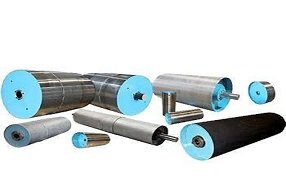
Permanent magnetic pulley are ideal magnetic products used as had pulley in belt conveyors. These pulleys offer superior removal of ferrous contamination like nails, spikes, nuts, bolts, cans, and wire from material conveyor with maintenance free operation.
The Master Magnets pulley separators and magnetic conveyor pulleys are an easy, reliable solution for the continuous extraction of ferrous metals such as iron or steel, and even weakly magnetic particles (such as particles from processed stainless steel) from coarse to very fine fractions and carries them away completely automatically and continuously. Magnetic pulley separators are installed as a replacement head pulley at the discharge end of a conveyor. A nonmagnetic adjustable diverter plate is installed beneath the pulley to split the ferrous material away from the non-ferrous materials in the product stream.
The magnetic field of the pulley attracts the ferrous fines which are held to the belt until it reaches the underside. The separated ferrous materials pass out of the magnetic field and are collected separately into a chute or bin. The cleaned material is discharged normally over the pulley in a vertical drop. The magnetic pulley is made up of magnets placed inside a Stainless Steel 304/316 drum shell on a shaft. All shafts are made up of steel and are amply supported to handle the required load. Shafts are carefully machined from over–size stock to required finished dimensions. The magnets are enclosed totally inside the stainless steel drum. These are installed as head pulley in belt conveyor. The self-cleaning magnetic pulleys are equally effective in the separation of both large and fine particles from non-ferrous material.
Tramp–iron contaminated material comes within the pulley’s magnetic field, the tramp iron is attracted and held to the belt until it reaches the underside, passes out of the magnetic field, and is separately discharged. The cleaned, nonmagnetic material is discharged over the pulley in a normal trajectory.
Applications
| • Mining | • Chemical products upgrading. | • Ceramic raw material cleaning. |
| • Bauxite cleaning. | • Refractory raw materials beneficiation. | • Calcined / dead burned products upgrading. |
| • To concentrate paramagnetic minerals such as Hematite, Ilmenite, Chromate, kimberlite, Staturolite, Monazite, Zircon and other feebly magnetic material. | • Diamond ore beneficiation / trace mineral production. | • In recovery of metal in iron ores (siderite. limonite). |
| • Beneficiation of beach sand / magnesite / wollastionite. | • Glass raw material Cleaning-Extremely high purity quartz cleaning. | • Salt processing industries |
| • Paper | • Recycling Applications | • Coal Handling Plant |
| • Glass | • Refractory | • Feed & grain |
| • Cement | • Graphite Upgrading | • Waste recovery |
| • Cola cleaning / desulphurization | • Andalusite and pyrophylite beneficiation | • Processing of casting sands (recovery of chromate.) |
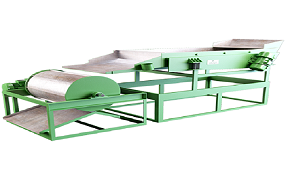
NUVEQ Roll Magnetic Separator is a roll type dry magnetic separator with fixed magnet having high field intense and gradient. The magnets used in the Roll Magnetic Separators and made of alloys of rare earth elements are more powerful as compared to other magnets. They generate high attraction forces on the magnetic roll due to their properties and special magnetic series. The obtained high magnetic attraction forces have low magnetic sensitivity and therefore they make it possible to separate very fine low magnetic minerals with a high recovery.
Drum separators are used in applications where there is a high throughput of material to be processed and where there is a need to extract smaller ferrous particles from a given product stream. Our magnetic separator range is available in a wide range of sizes to suit a customers specific throughput requirements and can either have an internal permanent or electromagnet system depending on the application.
Magnetic drums are constructed with a 180-degree stationary magnet system, around which a cover revolves. The material is fed onto the drum cover at the leading point of the magnet section. Magnetic materials will adhere to the drum cover as it revolves and will then be discharged behind the normal trajectory. Non-magnetic materials will free-fall forward following their normal trajectory. For applications that may involve co-mingled materials, Mastermag can offer a magnet system that features an alternating pole arrangement as shown in the image below. This magnetic separator system enables the entrapped ferrous materials to flip over the magnetic poles as they move over the surface of the drum and become free from the non-metallic product.
The most distinguishing property of Roll Magnetic Separator is the used magnets that are an alloy of rare earth elements produced domestically and more powerful. Magnetic Systems has a number of standard sizes in which the high gradient separator is produced, and all of these sizes only require a low installation height. It is also possible to make a system in accordance with customer specifications. Depending on the requirements made and the application, a choice can be made for a single stage system or for multiple magnet rolls under one another. This results in an even higher degree of iron separation.
Working Principle:
Roll Magnetic Separators consist of two rolls, one of which is magnetics. There is a belt between them to carry the ore into the magnetic field. The movement of the belt is controlled by a motor fixed to one of the rolls. The rotational speed of rolls can be adjusted according to the material properties.
The material to be processed is conveyed to the belt by vibrating feeder at a required rate. Feeding rate can be controlled by adjusting the vibration on feeder. A separator blade has been set in order to be able to collect separated products in different places and to adjust the product properties in a desired manner.
Applications
| • Silica | • Carbide | • Chromite recovery |
| • Graphite Upgrading | • Silica Sand | • Alumina |
| • Abrasive and refractory | • Raw materials cleaning | • Magnesite beneficiation |
| • Copper-nickel ore Pre- Concentration | • Manganese and glass send beneficiation | • Andalusite and pyrophylite beneficiation |
| • Diatomaceous earth cleaning and kyanite cleaning | • Iron ore beneficiation | • Diamond beneficiation |
| • Feldspar | • Dolomite | • Glass raw materials cleaning |
| • Wollastionite beneficiation | • Magnesite, Quartzite etc. | • Bauxite cleaning |
| • Feldspar cleaning | • Bauxite Upgrading | • Recovery of Metals from Slag |
| • Ceramic raw materials cleaning | • Metal value recovery from waste | • Ultra High Purity Quartz Cleaning |
| • Flint clay and Graphite beneficiation | • Removal of Ferro silicates from limestone Magnesite etc. | • Selective separation of garnet/ilmenite/rutile/zircon recovery |
Applications
o Recycling
Recovering metal from waste or purifying secondary materials by removing metals is vital for successful recycling. This is achieved by using Permanent and Electro Magnetic Separators.
Typical examples include: Recovering steel beverage and food cans from household waste, Recovering aluminum cans from household waste.
o Mineral Processing and Ceramics
Permanent and Electro Magnetic Separators are used to separate magnetically susceptible minerals. Examples include:
Removing iron bearing minerals from silica sand used in the production of glass.
Cleansing feldspar and clay used in the production of ceramics. Iron can cause defects and discoloration in the finished ceramic product.
o Mining and Quarrying
Magnetic Separation plays an important role in the mining sector. There are two fundamental applications:
Removing tramp metal to prevent damage to processing equipment such as crushers.
Enhance the purity of the ore by either recovering the valuable magnetic ore or removing unwanted magnetic minerals.
o Food Production
A wide variety of Magnetic Separation equipment can be found in most food processing plants. They are used to remove metal contamination. This prevents damage to processing equipment and ensures maximum food product quality.
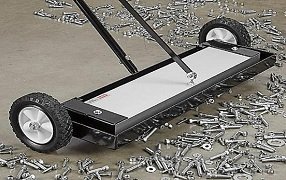
Magnetic Sweeper also referred to as Magnetic Broom is useful for quick clearing of dangerous ferrous scrap metals which include iron chips, shavings, nails, nuts, screws, tacks, barbed wire and staples etc.
Using Magnetic Sweepers is a quick, convenient, safe and time saving way to clean floors, driveways, construction areas, walkways, factory aisles, loading docks, packing lots and more.
A magnetic sweeper is a type of magnet that is used to pick up dropped pieces of ferromagnetic material e.g. screws , nuts, bolts and nails. Magnetic sweepers make cleaning up dropped material fast and easy. They do this by attracting all the small pieces of metal from the ground due to their magnetic pull, so there is little effort involved for the user.
They come in four forms: hand-held, push, forklift, or trailer. /n The pull force of the magnets within the magnetic sweeper attract the ferromagnetic material, and hold it in place. The larger the pull force of the magnetic sweeper, the more material it can attract. This is because pull force refers to the limit of holding power a magnet has. The pull force of a magnet is not determined by its overall size. This means that a large magnet does not necessarily have a larger pull force than a small magnet.
They can remove pieces of ferromagnetic material from workshop floors, fields, or even standing water. /n They are very useful in places where tires are burst frequently due to dropped pieces of ferromagnetic material. This can cost companies a lot of money unnecessarily. and so magnetic sweepers help to avoid this.
The pull force of the magnets within the magnetic sweeper attract the ferromagnetic material, and hold it in place. The larger the pull force of the magnetic sweeper, the more material it can attract. This is because pull force refers to the limit of holding power a magnet has. The pull force of a magnet is not determined by its overall size. This means that a large magnet does not necessarily have a larger pull force than a small magnet.
Types of Magnetic Sweeper
Push-Type Magnetic Sweeper with Release – Ideal for fast collection of nails, screws, or other metal items in assembly areas or warehouses.
Push-Type Magnetic Sweeper – Efficiently removes large quantities of dangerous scrap metal from machining areas and shop floors, and quickly wipes clean with a heavy shop towel.
Mini Magnetic Sweeper – Perfect for clean-up of metal items and debris in smaller areas, such as storage closets, office areas, and parts picking stations.
Hang-Type Magnetic Sweeper – Hangs from a forklift or vehicle bumper to clear hazardous metal items from roads, parking areas, loading docks, runways and other traffic areas.
Trailer-Type Magnetic Sweeper – Quickly clears metal debris from streets, construction sites, runways, or steel mills, and operates over wet or dry, smooth or unpaved surfaces.
Applications
| • Manufacturing Facilities | • Construction Businesses | • Material Handling Facilities |
| • Distribution Centers | • Parking Lots | • Playgrounds |
| • Stables | • Streets, Roads and Tracks | • Air Fields |
| • Airlines, Airports & Flight lines | • Warehousing & Distribution | • Aggregate & Materials Processing |
| • Trucking & Transportation | • Rental Centers | • Military |
| • Forklifts & Material Handling | • Roadway & Highway Maintenance | • Food Processing |
| • Equestrian Facilities & Fairgrounds |
Magnetic Liquid Traps consist of a group of strong magnetic grates and a housing outside. An inlet and outlet makes it possible to connect with existing processing line by various connection types. Magnetic Filters are used for filtration of iron particles from products in liquid/slurry form. They are essentially used in chemical, food, pharma and oil industries. They are also frequently used in hydraulic circuits in cooling systems. The Filter Magnets are made up of either Ceramic or High Intensity Rare Earth Magnets.
As liquids or slurries are pumped through the Liquid Trap, ferrous contaminants adhere to the strategically placed magnetic tubes. The design and construction allow the tramp iron to work around the downstream side of the tubes where it is safely out of product flow and wash off is prevented. Cleaning is achieved by removing the top plate and removing the magnetic assembly from the housing. The housing is designed not only to house the magnet, but also to act as a sump. Unwanted non-magnetic particles tend to gravitate to the bottom of the enclosure.
Magnetic filters are installed at a suitable location along the passage of fluid. The flowing liquid is made to travel around the magnetic field of high intensity filter magnets where fine ferrous particles get arrested in a magnetic trap.
These arrested fine iron particles can be removed manually after removing the top lid of the filter. Drain plug is provided at the bottom face for periodical cleaning of the filter system.
The unit comprises of a vessel, magnetic lid assembly and fasteners to secure the unit together. Magnetic system is made up of either Ceramic or High intensity Rare Earth magnets. The Magnet unit is enclosed in stainless steel housing making it suitable for use in Chemical, Paper & Ceramic Industry. The Magnetic Filter is easily removable from the stainless steel enclosure by loosening a few quick release fasteners.
Usually these liquid traps are simply mounted to the existing pipeline via flanged or threaded ends. Easy access is also possible using the quick release clamp.
Applications
| • Pigments | • Food Products. (Sugar, Coffee, Tea, Grains, Pulses, Flour, Spices, Milk etc.) | • Chemical |
| • Colors / Paints | • Ink | • Waste recovery |
| • Feed & grain | • Minerals (e.g. Bauxite) | • Graphite Upgrading |
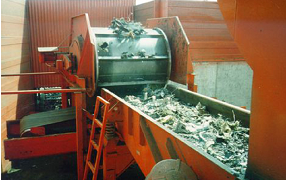
When material flows onto the drum, a stationary magnetic assembly inside the unit's shell captures tramp metal and holds it securely to the drum's stainless steel surface. With contaminants removed, the good product falls freely to a discharge point. As the drum rotates, cleats sweep the ferrous debris through and out of the magnetic field. The tramp metal is discharged separately, creating continuous self-cleaning separation.
Double and triple magnetic drum / High gradient magnetic separator / Double and triple rotating drum magnet / Double and triple type magnetic separator.
The magnetic drum separator consists of a rotating drum and stationary drum magnet designed as per the specific needs of the customer. The Drum separator is supplied with drive system and SS 304/316 housing along with feed regulating valve.
The multi-drum magnetic separator is a device for automatic and permanent removal of magnetic contaminants from loose mixtures. The magnetic system composed of several drums simplifies and speeds up the capture of undesirable ferromagnetic contaminants (including weak magnetic stainless steel), allows for automatic separation without production stoppage and assures the highest purity of the clean material. At the same time, the magnetic drum protects the following machinery (crushers, mills, etc.) processing the purified material from damage. The heart of the magnetic drum consists of magnetic cores (made from either ferrite or neodymium NdFeB magnets) in the shape of crescent around which the stainless steel drum rotates. The strong permanent magnets capture and drag the ferromagnetic impurities on the surface of the rotating drums. The ferrous pieces fall off beyond the magnetic axis of the upper drum, the purified material is poured onto the drum located below where the separation process is repeated in the same manner.
The double or triple magnetic drum can be placed at the output of a conveyor belt or below a hopper (unlike the magnetic pulley the magnetic drum is not an integral part of the conveyor). It is also possible to deliver the magnetic drum also in a stainless steel housing with two hoppers under the case. The non-magnetic materials fall into the first hopper, whereas the caught metal impurities are transported on the surface of the drum and fall off beyond the magnetic axis of the drum into the second hopper.
Applications
| • Minerals and Chemicals | • Food and Flour | • Plastics |
| • Grains | • Sand | • Fertilizers |
| • Abrasives | • Glass | • Slag |
| • Ores | • Rock | • Refractory |
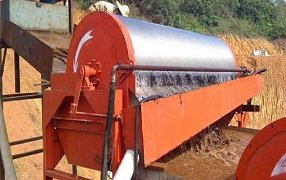
Low-intensity separators are used to treat ferromagnetic materials and some highly paramagnetic minerals. Minerals with ferromagnetic properties have high susceptibility at low applied field strengths and can therefore be concentrated in low intensity (<~0.3T) magnetic separators. For low-intensity drum separators used in the iron ore industry, the standard field, for a separator with ferrite-based magnets, is 0.12 T at a distance of 50 mm from the drum surface. Work has also shown that such separators have maximum field strengths on the drum surface of less than 0.3 T. The principal ferromagnetic mineral concentrated in mineral processing is magnetite (Fe3O4). although hematite (Fe2O3) and siderite Fe2CO3 can be roasted to produce magnetite and hence give good separation in low-intensity machines.
The wet drum magnetic separator is ideally used to separate ferrous particles from nonferrous particles. They are so made by us to provide ultimate protection to crushers, Grinders, Pulverizes and allied equipment and is useful for mining and ore dressing industry. It is so made that one side is magnetized and the other side is not.














Phone+91 8153 969 959
EmailEnquiry@nuveqcorp.com
Address204, World Trade Centre, Sayajiganj, Vadodara - 390020